Federica Sanchez, Tommaso Bertoni, Ashwanth Ramkumar, Elena Giancarli, Anna Custo, Andrea Serino
Neuroscience for Architecture
Why Neuroscience and Architecture
Space is something we cannot get away from. We are constantly immersed in it, and we experience it in every instant of our lives. Through advancements in neuroscientific knowledge and technology, nowadays it is possible to understand and predict how space affects human beings. Specifically, it is possible to reconduct the complexity of the phenomenological experience to quantifiable mental and neural processes. Our body and brain constantly receive information from the outer world though our senses, and this information is processed and integrated by the brain to build perceptions. These processes, though mostly unconscious, influence our feelings of comfort or discomfort, pleasantness, or unpleasantness. Higher cognitive functions further process this information, shaped by past experiences and expectations, leading to complex mental states like emotions, intentions, and behaviours. All these processes interact with each other, and space is their underlying medium. Thus, it has been widely demonstrated by theoretical research and experimental work that space is never neutral, but it has an impact on people's perception, emotional state, movement, behaviour, and ultimately wellbeing. For example, design features of hospitals can speed up recovery in patients (Ulrich, 1984), or office spaces and layouts influence cognitive performance in workers (Kaplan & Kaplan, 1989; Evans, G. W., & McCoy, J. M., 1998). In today's architectural practice, spaces are typically designed based on architectural history, styles, and designers' intuition and creativity. Only after the project is completed, it is possible to assess how people's behaviour and perception are affected by the design. Studying how our brain, and spatial cognition in particular, functions allows us to reverse the process: from the understanding of how architectural components impact our experience, it is possible to design space through an evidence-based approach where design intuitions are supported by empirical data. Application of data-driven and scientific principles to design seems particularly relevant to create spaces for vulnerable people, such as hospitalised patients, inmates, or children. More generally, we experience space all the time, so systematically integrating neuroscience and architecture into the design process can have beneficial effects on every environment we live.
Spatial Cognition
From a neuroscientific perspective, architecture provides a unique opportunity to understand and manipulate human experience. Human spatial cognition relies on two primary ways of representing space in the brain, each rooted in distinct neural networks: Egocentric representation: This form of spatial representation underlies the way we phenomenally experience space, from a first-person perspective, allowing interactions with objects in the immediate environment. It is primarily mediated by parieto-frontal, multisensory-motor networks, with a key role played by the peripersonal space system—the representation of the space immediately surrounding the body. This system enables embodied experience and direct interaction with the environment (Serino et al., 2019; Blanke et al., 2015). Allocentric representation: These map-like representations are built in mediotemporal regions including the hippocampus, entorhinal cortex, and parahippocampal cortex, which create and store spatial maps. These maps underlie navigation, memory formation, and re-navigation by providing a broader, global perspective of the environment, and are also described as value maps (Behrens et al., 2018). Although these systems are often studied independently in the scientific field, our experience of space is inherently a combination of the two. Understanding how these representations integrate in the brain is crucial for bridging the gap between neuroscience and everyday experiences of space. Architecture is a medium in which the egocentric and allocentric spatial representations interact: architects create abstract representations of space— plans and layouts—that people must navigate. However, their ultimate goal is to craft first-person experiential spaces, shaping how individuals perceive, explore, and remember environments.
Academic Research
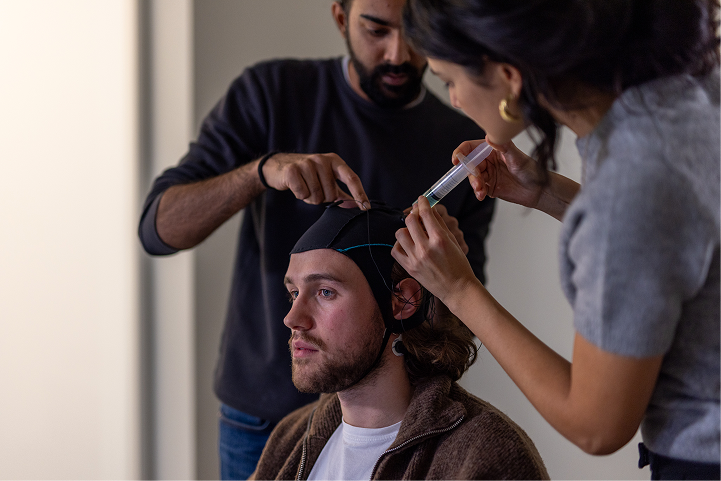
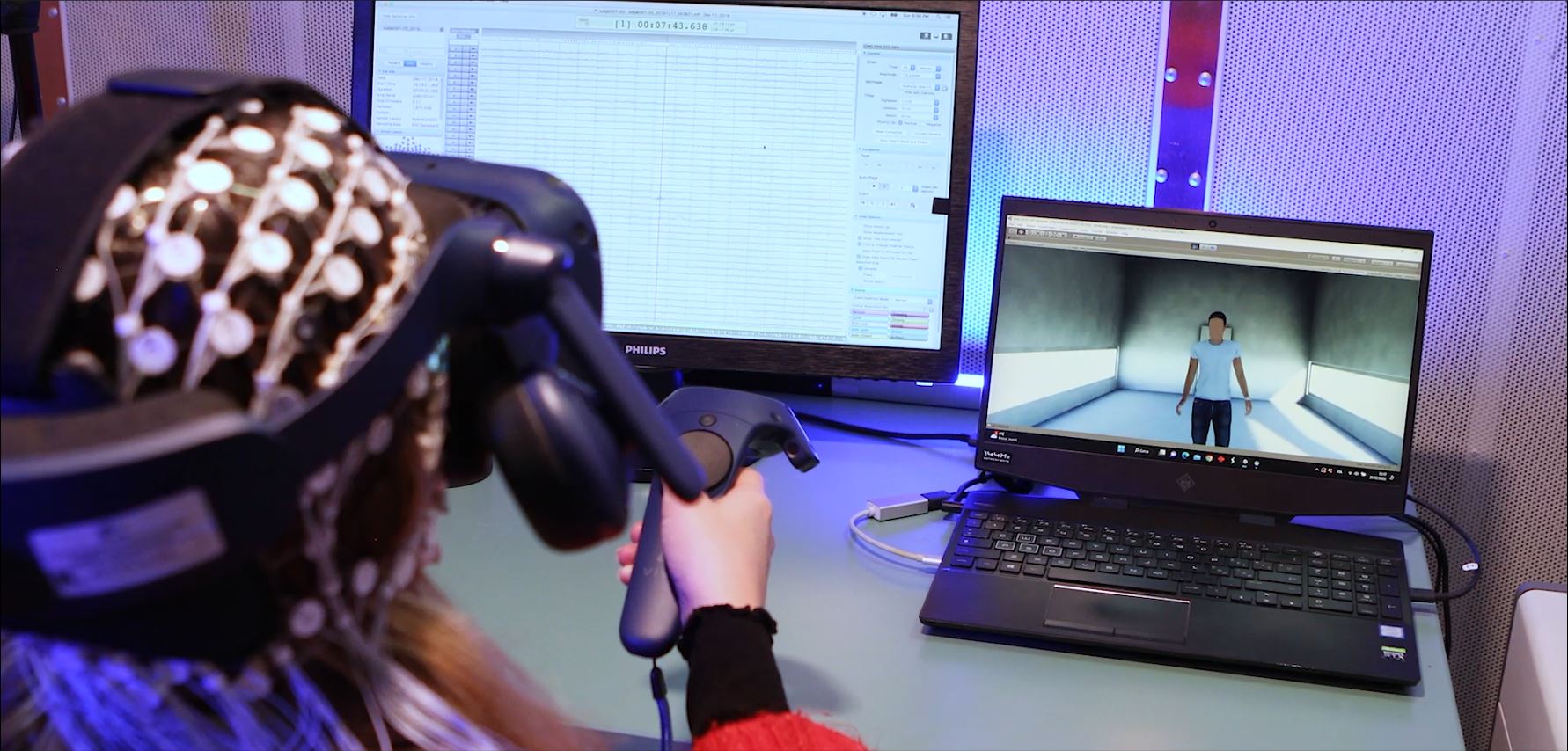
In 2019 Lombardini22 started a research collaboration with CNR-IN (Consiglio Nazionale delle Ricerche, Instituto di Neuroscienze), led by neuroscientist Giacomo Rizzolatti, that explored the effects of architectural space on human affective states and social cognition. Using Virtual Reality (VR), electroencephalography (EEG), and eye-tracking, the study investigated how the distance between the body and architectural partitions affects perception. The findings showed that larger spaces tend to reduce physiological activation, promoting feelings of relaxation and well-being, while tighter spaces increase physiological arousal and are perceived negatively, inducing discomfort (Presti et al., 2022). An important aspect of that research is the relationship between spatial perception and social cognition: the brain mechanisms involved in processing others' mental states and those responsible for encoding the surrounding space are interdependent. The study found that the experience of architecture influences the perception of others' emotional states (Presti et al., 2023). In less arousing spaces, participants spent more time focusing on others' faces, suggesting that relaxing environments enhance attentional capacity, which in turn affects social interactions and perceptions of others. Thus, low-arousal spaces may foster empathy and more meaningful social connections.
Real world application
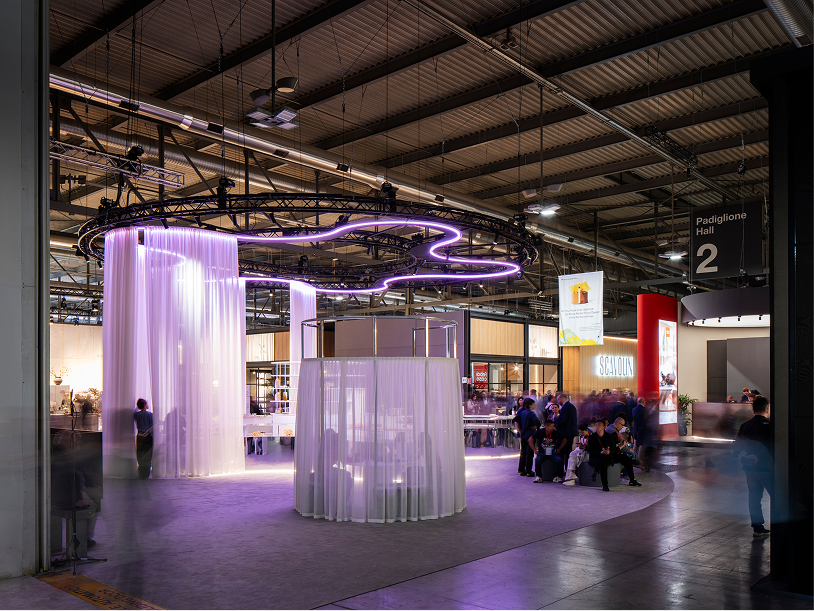
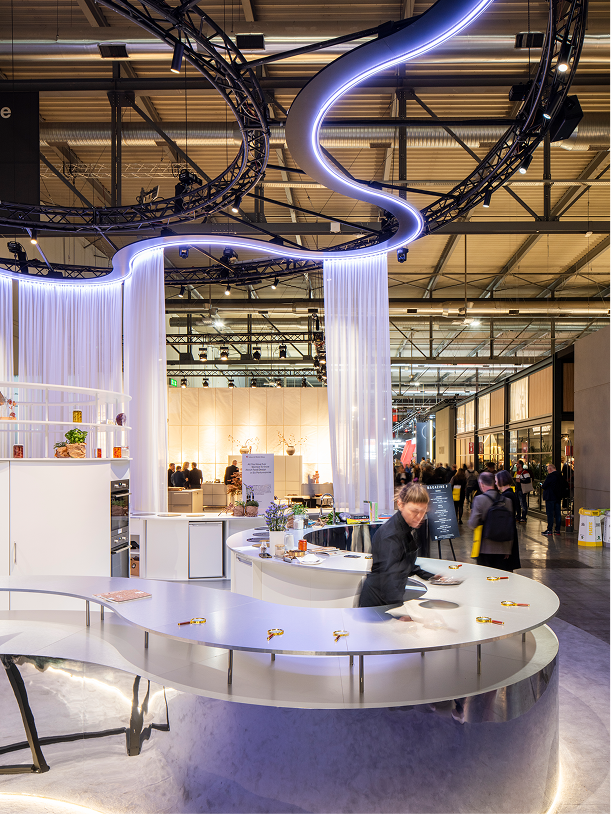
One of the latest projects in which we applied neuroscience principles to architecture, was a collaboration between the architects of Lombardini22 and the neuroscientists of MySpace Lab from Lausanne University Hospital. The project's aim was to redesign the layout of one pavilion of the exhibition space at Salone del Mobile 2024, Milan, Italy. At the beginning of the project, we noticed that the grid-based layout, common to most fairs around the world, characterised by stands with uniform shapes, orthogonal axes, and frequent intersections, works well for an efficient division of the available space to maximise the occupancy of the stands. However, from the visitor's point of view, this spatial organisation imposes cognitive and perceptual challenges. To avoid these undesirable effects, we proposed an ecological layout — inspired by natural exploration patterns — characterised by larger pathways, more distinctive landmarks, varied and curved path structures, and unobstructed sightlines. Through the collection of quantitative and qualitative data, we were able to demonstrate that a neuroscience-driven layout can enhance memory, orientation skills and reduce cognitive load and mental fatigue. The results of the VR phase showed a better score in spatial memory task and navigation (respectively +37% and +15% in the new design pavilion compared to the traditional grid-layout).
Limitations
This project demonstrated the potential value of neuroscience-inspired designing but taught us some lessons. Generalisability is a limit to the translation of any scientific findings into design practice: the difficulty is recreating the same experimental conditions in a new context and guaranteeing the observation of the same effects. Another critical point is timing. For instance, in the short term, the time required to run a scientific study, including data collection, to test design options hardly matches the rhythm of the design processes real estate professionals are used to. However, this empirical approach can offer significant long-term benefits, such as helping clients to save costs once the project is completed.
Exchange and translations between architects and neuroscientists
A successful neuroscience-for-architecture process benefits from a broad multidisciplinary collaboration, beyond just the neuroscientists and the architects. The complexity of understanding the relationship between humans and space requires many different points of view and skill sets. We believe that despite the challenges of integrating neuroscience into architecture, this interdisciplinary approach holds immense promise. As the field matures, we anticipate that neuroscience-inspired design will extend beyond laboratory studies and theoretical research to become an essential tool in real-world architectural practice.
References
Behrens, T. E., Muller, T. H., Whittington, J. C., Mark, S., Baram, A. B., Stachenfeld, K. L., & Kurth-Nelson, Z. 2018. What is a cognitive map? Organizing knowledge for flexible behavior. Neuron, 100(2), 490–509.
Blanke, O., Slater, M., & Serino, A. 2015. Behavioral, neural, and computational principles of bodily Self-Consciousness. Neuron, 88(1), 145–166.
Evans, G. W., & McCoy, J. M. 1998. When buildings don’t work: The role of architecture in human health. Journal of Environmental Psychology, 18(1), 85–94.
Kaplan, R., & Kaplan, S. 1989. The experience of nature: A psychological perspective. Cambridge University Press.
Presti, P., Ruzzon, D., Avanzini, P., Caruana, F., Rizzolatti, G., & Vecchiato, G. 2022b. Measuring arousal and valence generated by the dynamic experience of architectural forms in virtual environments. Scientific Reports, 12(1).
Presti, P., Galasso, G. M., Ruzzon, D., Avanzini, P., Caruana, F., Rizzolatti, G., & Vecchiato, G. 2023b. Architectural experience influences the processing of others’ body expressions. Proceedings of the National Academy of Sciences, 120(41).
Serino, A. 2019. Peripersonal space (PPS) as a multisensory interface between the individual and the environment, defining the space of the self. Neuroscience & Biobehavioral Reviews, 99, 138–159.
Ulrich, R. S. 1984b. View Through a Window May Influence Recovery from Surgery. Science, 224(4647), 420–421.

Federica Sanchez, Tommaso Bertoni, Ashwanth Ramkumar, Elena Giancarli, Anna Custo, Andrea Serino
Neuroscience for Architecture
Why Neuroscience and Architecture
Space is something we cannot get away from. We are constantly immersed in it, and we experience it in every instant of our lives. Through advancements in neuroscientific knowledge and technology, nowadays it is possible to understand and predict how space affects human beings. Specifically, it is possible to reconduct the complexity of the phenomenological experience to quantifiable mental and neural processes. Our body and brain constantly receive information from the outer world though our senses, and this information is processed and integrated by the brain to build perceptions. These processes, though mostly unconscious, influence our feelings of comfort or discomfort, pleasantness, or unpleasantness. Higher cognitive functions further process this information, shaped by past experiences and expectations, leading to complex mental states like emotions, intentions, and behaviours. All these processes interact with each other, and space is their underlying medium. Thus, it has been widely demonstrated by theoretical research and experimental work that space is never neutral, but it has an impact on people's perception, emotional state, movement, behaviour, and ultimately wellbeing. For example, design features of hospitals can speed up recovery in patients (Ulrich, 1984), or office spaces and layouts influence cognitive performance in workers (Kaplan & Kaplan, 1989; Evans, G. W., & McCoy, J. M., 1998). In today's architectural practice, spaces are typically designed based on architectural history, styles, and designers' intuition and creativity. Only after the project is completed, it is possible to assess how people's behaviour and perception are affected by the design. Studying how our brain, and spatial cognition in particular, functions allows us to reverse the process: from the understanding of how architectural components impact our experience, it is possible to design space through an evidence-based approach where design intuitions are supported by empirical data. Application of data-driven and scientific principles to design seems particularly relevant to create spaces for vulnerable people, such as hospitalised patients, inmates, or children. More generally, we experience space all the time, so systematically integrating neuroscience and architecture into the design process can have beneficial effects on every environment we live.
Spatial Cognition
From a neuroscientific perspective, architecture provides a unique opportunity to understand and manipulate human experience. Human spatial cognition relies on two primary ways of representing space in the brain, each rooted in distinct neural networks: Egocentric representation: This form of spatial representation underlies the way we phenomenally experience space, from a first-person perspective, allowing interactions with objects in the immediate environment. It is primarily mediated by parieto-frontal, multisensory-motor networks, with a key role played by the peripersonal space system—the representation of the space immediately surrounding the body. This system enables embodied experience and direct interaction with the environment (Serino et al., 2019; Blanke et al., 2015). Allocentric representation: These map-like representations are built in mediotemporal regions including the hippocampus, entorhinal cortex, and parahippocampal cortex, which create and store spatial maps. These maps underlie navigation, memory formation, and re-navigation by providing a broader, global perspective of the environment, and are also described as value maps (Behrens et al., 2018). Although these systems are often studied independently in the scientific field, our experience of space is inherently a combination of the two. Understanding how these representations integrate in the brain is crucial for bridging the gap between neuroscience and everyday experiences of space. Architecture is a medium in which the egocentric and allocentric spatial representations interact: architects create abstract representations of space— plans and layouts—that people must navigate. However, their ultimate goal is to craft first-person experiential spaces, shaping how individuals perceive, explore, and remember environments.
Academic Research
In 2019 Lombardini22 started a research collaboration with CNR-IN (Consiglio Nazionale delle Ricerche, Instituto di Neuroscienze), led by neuroscientist Giacomo Rizzolatti, that explored the effects of architectural space on human affective states and social cognition. Using Virtual Reality (VR), electroencephalography (EEG), and eye-tracking, the study investigated how the distance between the body and architectural partitions affects perception. The findings showed that larger spaces tend to reduce physiological activation, promoting feelings of relaxation and well-being, while tighter spaces increase physiological arousal and are perceived negatively, inducing discomfort (Presti et al., 2022). An important aspect of that research is the relationship between spatial perception and social cognition: the brain mechanisms involved in processing others' mental states and those responsible for encoding the surrounding space are interdependent. The study found that the experience of architecture influences the perception of others' emotional states (Presti et al., 2023). In less arousing spaces, participants spent more time focusing on others' faces, suggesting that relaxing environments enhance attentional capacity, which in turn affects social interactions and perceptions of others. Thus, low-arousal spaces may foster empathy and more meaningful social connections.
Real world application
One of the latest projects in which we applied neuroscience principles to architecture, was a collaboration between the architects of Lombardini22 and the neuroscientists of MySpace Lab from Lausanne University Hospital. The project's aim was to redesign the layout of one pavilion of the exhibition space at Salone del Mobile 2024, Milan, Italy. At the beginning of the project, we noticed that the grid-based layout, common to most fairs around the world, characterised by stands with uniform shapes, orthogonal axes, and frequent intersections, works well for an efficient division of the available space to maximise the occupancy of the stands. However, from the visitor's point of view, this spatial organisation imposes cognitive and perceptual challenges. To avoid these undesirable effects, we proposed an ecological layout — inspired by natural exploration patterns — characterised by larger pathways, more distinctive landmarks, varied and curved path structures, and unobstructed sightlines. Through the collection of quantitative and qualitative data, we were able to demonstrate that a neuroscience-driven layout can enhance memory, orientation skills and reduce cognitive load and mental fatigue. The results of the VR phase showed a better score in spatial memory task and navigation (respectively +37% and +15% in the new design pavilion compared to the traditional grid-layout).
Limitations
This project demonstrated the potential value of neuroscience-inspired designing but taught us some lessons. Generalisability is a limit to the translation of any scientific findings into design practice: the difficulty is recreating the same experimental conditions in a new context and guaranteeing the observation of the same effects. Another critical point is timing. For instance, in the short term, the time required to run a scientific study, including data collection, to test design options hardly matches the rhythm of the design processes real estate professionals are used to. However, this empirical approach can offer significant long-term benefits, such as helping clients to save costs once the project is completed.
Exchange and translations between architects and neuroscientists
A successful neuroscience-for-architecture process benefits from a broad multidisciplinary collaboration, beyond just the neuroscientists and the architects. The complexity of understanding the relationship between humans and space requires many different points of view and skill sets. We believe that despite the challenges of integrating neuroscience into architecture, this interdisciplinary approach holds immense promise. As the field matures, we anticipate that neuroscience-inspired design will extend beyond laboratory studies and theoretical research to become an essential tool in real-world architectural practice.
References
Behrens, T. E., Muller, T. H., Whittington, J. C., Mark, S., Baram, A. B., Stachenfeld, K. L., & Kurth-Nelson, Z. 2018. What is a cognitive map? Organizing knowledge for flexible behavior. Neuron, 100(2), 490–509.
Blanke, O., Slater, M., & Serino, A. 2015. Behavioral, neural, and computational principles of bodily Self-Consciousness. Neuron, 88(1), 145–166.
Evans, G. W., & McCoy, J. M. 1998. When buildings don’t work: The role of architecture in human health. Journal of Environmental Psychology, 18(1), 85–94.
Kaplan, R., & Kaplan, S. 1989. The experience of nature: A psychological perspective. Cambridge University Press.
Presti, P., Ruzzon, D., Avanzini, P., Caruana, F., Rizzolatti, G., & Vecchiato, G. 2022b. Measuring arousal and valence generated by the dynamic experience of architectural forms in virtual environments. Scientific Reports, 12(1).
Presti, P., Galasso, G. M., Ruzzon, D., Avanzini, P., Caruana, F., Rizzolatti, G., & Vecchiato, G. 2023b. Architectural experience influences the processing of others’ body expressions. Proceedings of the National Academy of Sciences, 120(41).
Serino, A. 2019. Peripersonal space (PPS) as a multisensory interface between the individual and the environment, defining the space of the self. Neuroscience & Biobehavioral Reviews, 99, 138–159.
Ulrich, R. S. 1984b. View Through a Window May Influence Recovery from Surgery. Science, 224(4647), 420–421.